

A self-harm relapse can leave parents feeling scared, confused and unsure how to respond. You may feel panic, sadness, anger or guilt all at once. You may wonder if your teen’s progress is gone or if you missed an important warning sign.
If your teen is in immediate danger, has serious injuries, is talking about suicide or cannot stay safe, call 911 or go to the nearest emergency room. If your teen is having thoughts of self-harm or suicide, call or text 988 to reach the Suicide & Crisis Lifeline.
A relapse in self-harm can be deeply upsetting, but it doesn’t mean your teen is hopeless, manipulative or “starting over.” It often means their emotional distress became stronger than their coping skills in that moment. Parents can respond in a way that protects safety, lowers shame and helps their teen reconnect with professional support.
Why do people self-harm?
Self-harm is the intentional act of hurting one’s own body, often as a way to cope with emotional pain, numbness, anger, shame or distress. Self-harm is not always a suicide attempt, but it is always serious and should be addressed with care.
Some people use self-harm to cope with difficult feelings such as loneliness, anger or hopelessness.
Teens may self-harm for different reasons, including:
- Emotional overload — Feelings become too intense to manage.
- Numbness — A teen wants to feel something when they feel disconnected.
- Shame — A teen may punish themselves when they feel worthless.
- Stress relief — Self-harm may bring short-term relief, even though it creates more risk.
- Communication — A teen may not know how to express pain in words.
Self-injury often begins in the preteen or early teen years, when emotional changes, peer pressure, loneliness and family conflict may feel intense.
How parents can respond after a self-harm relapse
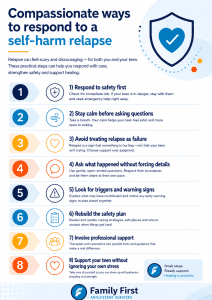
After immediate safety is addressed, these steps can help parents respond with calm support, reduce shame and reconnect their teen with professional care.
1. Respond to safety first
Before talking through what happened, focus on immediate safety. Stay as calm as possible and check whether your teen needs medical care.
Parents should seek urgent help if:
- Injuries are serious — The injury needs medical attention.
- Suicide is mentioned — Your teen talks about wanting to die or not wanting to live.
- Your teen cannot stay safe — They say they may self-harm again soon.
- Substance use is involved — Alcohol or drugs may increase risk.
- You feel unsure — You’re not confident your teen is safe.
If the situation isn’t an emergency, still take the relapse seriously. Help your teen move to a safe, supervised space and contact a mental health professional for guidance.
2. Stay calm before asking questions
Your first reaction matters. A shocked or angry response may increase shame and make your teen less likely to talk. This doesn’t mean you should hide your concern. It means leading with calm safety instead of panic.
Try saying:
“I’m really glad you told me. I’m not angry. I want to help keep you safe.”
You might also say, “I can see you are in a lot of pain, and I want to understand how to help.”
Avoid saying:
- “Why would you do this?”
- “You promised you would stop.”
- “You were doing so well.”
- “Are you just trying to get attention?”
These comments may come from fear, but they can make a teen feel judged. A calmer response helps keep the conversation open.
3. Avoid treating relapse as failure
A self-harm relapse can feel discouraging, especially if your teen had gone weeks or months without self-harming. Still, relapse doesn’t erase progress. It may show that your teen needs more support, a clearer safety plan or stronger coping tools.
A relapse may be a signal that your teen needs more support, different coping strategies or help navigating a high-stress situation.
Not everyone who self-harms wants to end their life. Some people describe self-harm as a way of coping with severe emotional distress.
Parents can help by separating the behavior from the person. Your teen isn’t “bad” for relapsing. They’re struggling and need help responding differently next time.
4. Ask what happened without forcing details
After safety is addressed, gently ask what led up to the relapse. You don’t need every detail. The goal is to understand patterns.
Focus on the emotion beneath the behavior, not only the behavior itself.
Helpful questions may include:
- “What was happening before the urge started?”
- “Were you feeling angry, numb, scared or overwhelmed?”
- “Did anything make it harder to use your coping skills?”
- “What support would help right now?”
Don’t pressure your teen to explain everything at once. Some teens need time before they can talk clearly. Others may feel too ashamed to answer. Staying patient can help your teen feel safer.
5. Look for triggers and warning signs
A relapse often happens after stress builds over time. Parents can help by noticing patterns without blaming their teen.
Common triggers may include:
- Conflict — Arguments with family, friends or peers
- Isolation — Spending long periods alone or withdrawing from support
- Shame — Feeling embarrassed, rejected or like a burden
- Trauma reminders — Situations that bring up painful memories
- Academic stress — Pressure around grades, school or future plans
- Sleep problems — Exhaustion can make coping harder
Parents may also notice warning signs, such as new secrecy, covering the body more often, avoiding activities, sudden mood changes or pulling away from family. These signs do not confirm self-harm, but they may show that your teen needs closer support.
6. Rebuild the safety plan
A relapse is an important time to update your teen’s safety plan. A safety plan is a clear list of steps your teen and family can use when self-harm urges return.
A plan may include:
- Warning signs — How your teen knows distress is building.
- Coping skills — Calming strategies your teen can try first.
- Support people — Trusted adults your teen can contact.
- Safe spaces — Places where your teen can be supervised and supported.
- Emergency steps — When to call 988 to reach the Suicide & Crisis Lifeline, 911 or a treatment provider.
- Reduced access — Ways parents can limit access to items that could be used for self-injury.
Mayo Clinic recommends learning about a loved one’s relapse prevention plan so family members can support the strategies developed with a therapist.
Safety planning should be done with a qualified professional whenever possible. Parents should not have to manage serious self-harm concerns alone.
7. Involve professional support
If your teen has a self-harm relapse, it may be helpful to contact their therapist, psychiatrist, pediatrician or treatment team. If they don’t currently have professional support, this may be the time to seek an assessment.
Professional care may help teens:
- Understand urges — Learn what emotions or situations increase risk.
- Build coping skills — Practice safer ways to handle distress.
- Treat co-occurring concerns — Address anxiety, depression, trauma or substance use.
- Strengthen communication — Learn how to ask for help before a crisis.
- Support the family — Help parents respond with structure and compassion.
Some teens may need a higher level of care if self-harm is repeated, severe, hidden or connected to suicidal thoughts. A clinical assessment can help determine what level of support is appropriate.
8. Support your teen without ignoring your own stress
Parents often carry fear and guilt after a self-harm relapse. You may replay past conversations or wonder what you should have done differently. Those feelings are understandable, but blame rarely helps families move forward.
Your teen needs support. You do too. Family therapy, parent coaching or caregiver support can help you respond with steadiness instead of panic.
Parents can also practice:
- Taking breaks — Step away briefly when emotions are high and another safe adult is present
- Asking for help — Contact your teen’s care team or crisis resources when needed
- Keeping routines — Meals, sleep and school structure can support stability
- Repairing after conflict — Apologize when needed and return to connection
You don’t need to respond perfectly. A steady pattern of care matters more than one perfect conversation.
After a self-harm relapse, Family First helps families focus on safety
At Family First Adolescent Services, we understand that a self-harm relapse can affect the whole family. Parents may feel frightened, while teens may feel ashamed, overwhelmed or unsure how to ask for help.
Families don’t have to manage a self-harm relapse in isolation.
Family First provides care in a safe, structured and supportive environment where teens can explore themselves, strengthen coping skills and find a better way forward. Our team looks beyond the behavior to better understand the emotional pain, stress or mental health concerns that may be connected to self-harm.
Family involvement is central to care. Parents stay actively connected through family therapy, parent support and daily communication with the treatment team. This helps families understand progress and support new skills at home.
For families facing urgent concerns, Family First offers fast admissions responses to help reduce uncertainty and connect families with support quickly.
Frequently asked questions
What is a self-harm relapse?
A self-harm relapse means a person returns to self-harming after a period of not doing it. It can be serious, but it doesn’t mean all progress is gone.
Why do self-harm relapses happen?
Relapses may happen when emotional distress, shame, anger, trauma reminders or stress become stronger than a teen’s coping skills. A professional can help identify patterns.
Does a self-harm relapse mean my teen is suicidal?
Not always. Self-harm and suicidal thoughts are different, but both require serious attention. If suicide is mentioned or safety is uncertain, call 988 to reach the Suicide & Crisis Lifeline, 911 or seek emergency care.
Should I punish my teen after a self-harm relapse?
Punishment often increases shame and secrecy. Clear safety limits matter, but parents should focus first on calm support, professional guidance and reducing immediate risk.
What should I say after a self-harm relapse?
Try saying, “I’m glad you told me. I’m not here to shame you. I want to help keep you safe.” Calm words can help your teen stay connected.
Why do people self harm?
Some people self-harm to cope with emotional pain, numbness, anger, shame or distress. It may bring short-term relief, but it creates serious safety risks.
Can therapy help with self-harm urges?
Yes. Therapy may help teens understand triggers, build coping skills, treat related concerns and create a safety plan for moments of high distress.
What are warning signs that self-harm may happen again?
Warning signs may include isolation, covering injuries, mood changes, increased secrecy, hopeless comments or avoiding support. These signs should be taken seriously.
When should parents seek emergency help?
Seek emergency help if injuries are serious, your teen mentions suicide, cannot stay safe or seems at immediate risk. Call 911 or go to the nearest emergency room.
How does Family First help after a self-harm relapse?
Family First supports teens through structured care, therapy, coping skill development and active family involvement. Parents receive daily communication and support throughout treatment.