

Trauma counseling for teens can be an important support when a teen boy’s emotions, behavior or relationships change after painful or overwhelming experiences. Trauma doesn’t always look like fear or sadness. Some teen boys become angry, distant, restless, numb or harder to reach.
Parents may notice that their son seems different but may not know why. He may avoid talking about what happened. He may say he is fine while his actions show that something is wrong.
Trauma refers to an experience that feels deeply distressing or overwhelming and disrupts a teen’s sense of safety. Trauma can include abuse, neglect, violence, bullying, loss, accidents, medical events, family instability or other experiences that overwhelm a teen’s ability to feel safe and cope. Not every stressful event causes lasting trauma symptoms. Many teens recover with time and support. Trauma becomes more concerning when emotional or behavioral changes continue, worsen or interfere with daily life.
The signs of trauma in teens can overlap with anxiety, depression, substance use, ADHD or normal stress. This is why families should avoid self-diagnosis and seek a professional evaluation when symptoms are persistent or unsafe.
Why trauma may affect teen boys differently
Teen boys may feel pressure to appear strong, independent or unaffected. Some boys hide distress because they do not want to seem weak. Others may not have the words to explain what they are feeling.
Instead of saying, “I feel scared,” a teen may argue, shut down or avoid people. Instead of saying, “I feel unsafe,” he may act controlling, restless or on edge.
Trauma-informed care recognizes that behavior may be connected to past or current stress. Trauma-informed approaches recognize the widespread impact of trauma, understand signs and symptoms and respond in ways that reduce the chance of retraumatization.
Ways trauma may affect teen boys emotionally and behaviorally
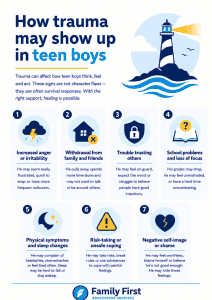
Trauma can affect mood, relationships, school, safety and self-image, so parents may notice several changes before their teen can explain what is wrong.
1. Increased anger or irritability
Some teen boys show trauma through anger. They may snap quickly, argue often or react strongly to limits. Parents may feel like they are walking on eggshells.
This doesn’t mean the anger is acceptable or safe. Clear boundaries still matter. It does mean the anger may be connected to fear, shame or feeling out of control.
Parents may notice:
- Sudden outbursts — Reactions seem larger than the situation
- Defensiveness — A teen becomes angry when asked simple questions
- Conflict at home — Arguments happen more often
- Trouble calming down — A teen stays upset long after the conflict ends
Anger can also be a way to push others away before the teen feels too vulnerable.
2. Withdrawal from family and friends
One of the common signs of trauma in teens is withdrawal. A teen boy may spend more time alone, stop sharing details about his life or lose interest in people he once enjoyed.
Withdrawal may look like:
- Staying in his room — He avoids family time or conversation.
- Dropping activities — He quits sports, clubs or hobbies.
- Avoiding friends — He pulls away from supportive relationships.
- Giving short answers — He says “fine” or “nothing” often.
Withdrawal can be a coping response. A teen may feel safer when he doesn’t have to explain himself. Over time, isolation can make distress harder to notice.
Some teens may also avoid people, places or situations that remind them of what happened.
3. Trouble trusting others
Trauma can affect how teen boys view relationships. A teen who has been hurt, rejected, bullied or exposed to instability may struggle to trust others. He may expect criticism, betrayal or conflict even when people are trying to help.
This can show up as:
- Pushing people away — A teen rejects support before it feels uncomfortable.
- Testing limits — He checks whether adults will stay consistent.
- Suspicion — He questions motives or assumes others are judging him.
- People-pleasing — He agrees to things to avoid conflict or rejection.
Trust often builds slowly. Parents can support this process through consistency, honesty and calm follow-through.
4. School problems and loss of focus
Trauma can affect attention, memory and motivation. A teen boy may struggle to focus in class, finish assignments or stay organized. This can look like laziness, but it may be linked to emotional overload.
School concerns may include:
- Falling grades — Performance drops even when the teen is capable
- Missed assignments — Work feels hard to start or complete
- Absences — A teen avoids school or complains of feeling sick
- Trouble with authority — Conflict with teachers or coaches increases
People can experience many reactions after trauma. Symptoms may continue for some people and may be diagnosed as post-traumatic stress disorder when they meet clinical criteria.
Parents can ask what feels hardest instead of assuming the teen doesn’t care. School struggles may be one sign that teen trauma therapy could be helpful.
5. Physical symptoms and sleep changes
Trauma can affect the body as well as emotions. Some teen boys report headaches, stomachaches, muscle tension, fatigue or trouble sleeping. Others may feel restless or keyed up.
Some teens may seem constantly on high alert, as if they’re bracing for something bad to happen.
Sleep changes may include trouble falling asleep, nightmares, waking often or sleeping too much. A teen may seem exhausted but still unable to relax.
Children who have long-term symptoms after a traumatic event may need evaluation when symptoms are upsetting or interfere with relationships and activities.
Physical symptoms shouldn’t be dismissed. A medical provider can help rule out health concerns. If symptoms appear alongside emotional or behavioral changes, trauma may also be part of the picture.
6. Risk-taking or unsafe coping
Some teen boys cope with trauma through risky behavior. They may use substances, drive recklessly, fight, sneak out or engage in unsafe sexual behavior. Others may self-harm or make comments that life feels pointless.
These behaviors should be taken seriously. They may be signs that a teen is trying to escape emotional pain or regain a sense of control.
If your teen talks about suicide, self-harm or not wanting to live, call or text 988 for the Suicide & Crisis Lifeline. Call 911 or go to the nearest emergency room if there is immediate danger.
7. Negative self-image or shame
Trauma can affect how teen boys see themselves. Some begin to believe they are weak, broken, bad or responsible for what happened. Others may seem confident on the outside while feeling deep shame inside.
Parents may hear statements like:
- “It doesn’t matter.”
- “I don’t care.”
- “I mess everything up.”
- “Nobody gets it.”
- “Just leave me alone.”
These statements may not tell the whole story. A teen may be protecting himself from feelings that are hard to express.
Family support can help teens feel less alone, but trauma-related shame may need professional care. Childhood trauma treatment can help families understand how trauma affects emotions, behavior and relationships.
When to consider trauma counseling for teens
Parents may want to consider trauma counseling for teens when changes last for weeks, create safety concerns or interfere with daily life. Support may also be helpful if your teen avoids reminders of the event, has nightmares, seems constantly on edge or struggles with intense shame.
Trauma counseling can give teens a safe place to talk about difficult experiences, learn coping skills and understand their reactions.
Teen trauma therapy may include trauma-focused therapy, family therapy, skills-based support, psychiatric care or other approaches based on the teen’s needs. Treatment should be guided by a qualified professional who can assess symptoms, safety and level of care.
Parents can support their teen by:
- Staying calm — Use a steady tone when emotions rise
- Listening first — Let your teen share without forcing details
- Keeping routines — Predictable sleep, meals and school structure can help
- Watching safety — Take self-harm, substance use or hopeless comments seriously
- Seeking support — Contact a therapist, pediatrician or treatment provider when concerns continue
At home, steady routines, calm communication and predictable boundaries can help create a more supportive environment.
Professional help isn’t a sign that the family has failed. It can give teens and parents more support during a difficult time.
When trauma changes your teen, Family First can help guide the next step
At Family First Adolescent Services, we understand that trauma can affect the whole family, not just the teen who experienced it. Parents may feel confused, worried or unsure how to respond when their son’s behavior changes.
Family First provides care in a safe, structured and supportive environment where teen boys can explore themselves, build coping skills and find a better way forward. Our team looks beyond surface behavior to better understand the emotional pain, stress or trauma responses that may be involved.
Family involvement is central to care. Parents stay actively involved through family therapy, parent support and daily communication with the treatment team. This helps families understand progress and support new skills at home.
For families facing urgent concerns, Family First offers fast admissions responses to help reduce uncertainty and connect families with care quickly.
Frequently asked questions
What is trauma counseling for teens?
Trauma counseling for teens is therapy that helps adolescents understand and manage the effects of stressful or overwhelming experiences. It should be guided by a qualified mental health professional.
What are common signs of trauma in teens?
Signs may include anger, withdrawal, sleep changes, school problems, avoidance, shame, risk-taking or trouble trusting others. These signs don’t confirm a diagnosis, but they may show that support is needed.
How can trauma affect teen boys emotionally?
Trauma may be linked to fear, anger, shame, numbness, sadness or feeling unsafe. Some teen boys may hide these feelings behind silence, jokes or irritability.
How can trauma affect teen boys behaviorally?
Behavioral changes may include arguments, isolation, school refusal, substance use, self-harm, risky choices or trouble with rules. A professional evaluation can help clarify what is happening.
When should parents seek teen trauma therapy?
Parents may want to seek help when symptoms last for weeks, worsen over time or interfere with school, safety, relationships or daily routines.
Does trauma always lead to PTSD?
No. Many teens experience stress after trauma and improve with time and support. PTSD is a diagnosable condition that requires specific symptoms and clinical evaluation.
Can trauma look like defiance?
Yes, sometimes. A teen who feels unsafe, overwhelmed or ashamed may argue, shut down or avoid adults. This doesn’t excuse unsafe behavior, but it may help explain it.
Can family therapy help after trauma?
Family therapy may help parents and teens improve communication, rebuild trust and respond to symptoms with more structure and compassion.
What should I do if my teen talks about self-harm?
Take it seriously. Call or text 988 for the Suicide & Crisis Lifeline for crisis support. Call 911 or go to the nearest emergency room if there is immediate danger.
How does Family First help teen boys affected by trauma?
Family First provides structured treatment, trauma-informed support, therapy and active family involvement. Parents receive daily communication and guidance throughout care.