

A teen may sit in front of an open assignment without beginning. He may know the deadline, understand the directions and still feel unable to start. Parents comparing ADHD paralysis and executive dysfunction often wonder whether these experiences are the same. Family First Adolescent Services provides individualized ADHD treatment that helps boys ages 12–18 understand these patterns and build practical skills.
“ADHD paralysis” is an informal phrase, not a clinical diagnosis. People often use it to describe feeling mentally stuck, overwhelmed or unable to begin. Executive dysfunction is a broader term for difficulty using skills needed to plan, organize, focus, remember steps and regulate behavior.
The two can overlap, but they are not interchangeable. Understanding the distinction may help families respond with support instead of assuming a teen is lazy or refusing to cooperate.
What is ADHD paralysis?
ADHD paralysis describes moments when a person wants or needs to act but cannot seem to begin, choose or move forward. The teen may stare at a task, switch between options or avoid it while feeling distressed.
Possible contributors include:
- Too many choices or competing demands
- Unclear instructions
- Fear of making a mistake
- Difficulty estimating time
- Low interest or delayed rewards
- Emotional overload
- Trouble deciding which step comes first
A teen may appear inactive while experiencing intense internal effort. Because the term is informal, clinicians may instead discuss task initiation, overwhelm, avoidance or executive function difficulties.
What is executive dysfunction?
Executive function refers to mental skills that support planning, attention, working memory, flexible thinking and self-control. These abilities continue developing through adolescence and early adulthood.
Executive dysfunction means a person has trouble using one or more of these skills consistently. A teen may forget assignments, underestimate time, lose materials or struggle to switch tasks. Problems may appear across school, home and relationships.
Executive dysfunction can occur with ADHD, autism, depression, anxiety, learning differences, sleep problems and other conditions. It is not a diagnosis by itself. ADHD also cannot be confirmed from one behavior because several concerns can produce similar difficulties.
Key ways ADHD paralysis and executive dysfunction differ
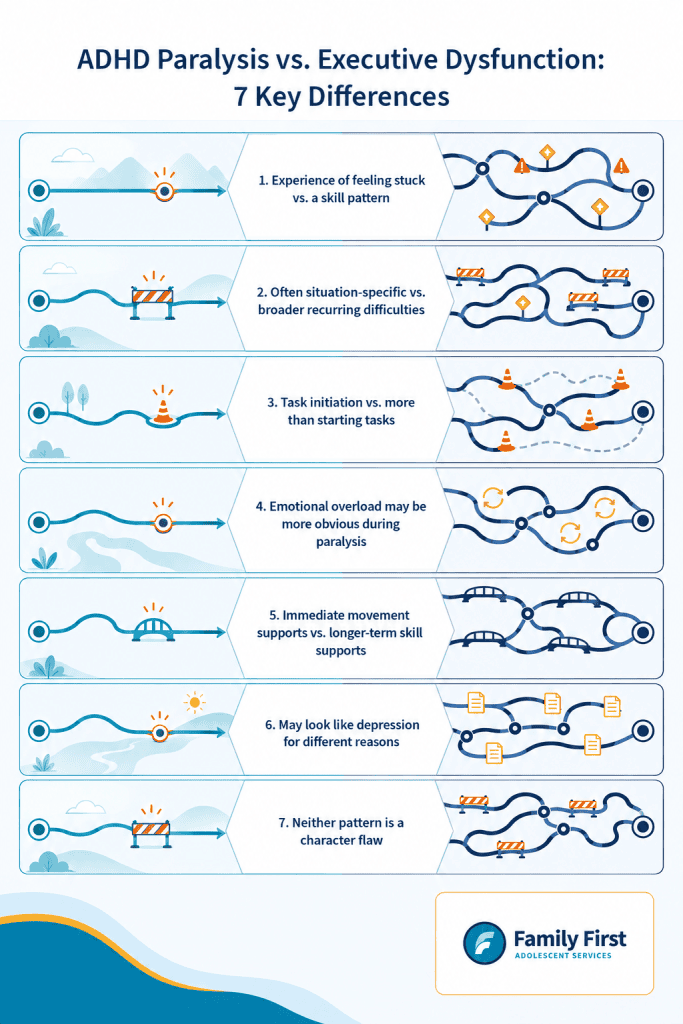
ADHD paralysis and executive dysfunction can overlap, but they describe different parts of a teen’s experience. The seven distinctions below can help parents understand what may be creating the difficulty and which types of support may be useful. These patterns are educational and should not replace a professional evaluation.
-
ADHD paralysis describes an experience, while executive dysfunction describes a skill pattern
The first difference is scope. ADHD paralysis usually refers to a specific experience of feeling stuck. Executive dysfunction refers to ongoing difficulty with a group of thinking and self-management skills.
A teen may experience paralysis when choosing among several overdue assignments. The broader executive difficulties may include poor time awareness, weak planning and trouble prioritizing.
The visible pause is only one part of the pattern. Support may need to address the skills that made the situation overwhelming.
-
Paralysis is often situation-specific
ADHD paralysis may appear during certain tasks but not others. A teen might struggle to begin an essay while starting a preferred game or creative project with little difficulty.
Interest, urgency, structure and immediate feedback can affect task initiation. This does not mean the teen could complete every task easily if he cared more.
Executive dysfunction tends to appear more broadly. The teen may have recurring trouble with planning, remembering steps, managing time or changing direction across many situations. Difficulty organizing or finishing tasks is also associated with the inattentive presentation of ADHD.
-
Executive dysfunction includes more than starting tasks
Task initiation is one executive skill, but it is not the only one. A teen may begin quickly and still struggle to complete the work.
Executive dysfunction may affect:
- Planning — Deciding what needs to happen and in what order
- Working memory — Holding instructions in mind while acting
- Time management — Estimating duration and tracking deadlines
- Inhibition — Pausing before acting on an impulse
- Flexibility — Adjusting when plans change
- Self-monitoring — Noticing errors and reviewing progress
- Emotional control — Managing reactions well enough to continue
A teen who experiences ADHD paralysis may have difficulty in several of these areas. Another teen may have executive dysfunction without describing a frozen feeling.
-
Emotional overload may be more obvious during paralysis
ADHD paralysis often involves anxiety, shame, frustration or fear of failing. As those feelings rise, beginning the task may become harder.
Parents may see avoidance, irritability or withdrawal. Repeating “just start” may increase pressure without showing the teen how to begin.
Executive dysfunction can also involve emotion, but it may look less dramatic. A teen may regularly misplace items or miss deadlines without a clear episode of overwhelm.
A calm response can help. Parents can reduce choices, identify one first step and give the teen time to regain focus.
-
The helpful supports may differ
During a paralysis episode, the immediate goal is often to reduce overload and create movement. Helpful steps may include:
- Removing unrelated materials
- Naming one small action
- Offering two choices instead of many
- Using a short timer
- Sitting nearby without taking over
- Allowing a brief reset
Longer-term executive function support may involve calendars, visual routines, checklists, school accommodations and repeated practice. The teen may need coaching on estimating time, organizing materials and dividing projects into stages.
Both forms of support should be collaborative. A strategy is useful only when the teen can understand and use it consistently.
-
ADHD paralysis and depression can look similar for different reasons
The comparison between ADHD paralysis and depression requires care. Both may involve delayed work, low activity and difficulty getting started. The experience behind those behaviors may differ.
ADHD-related paralysis often centers on task demands, competing choices or trouble activating attention. Once the teen starts or the task becomes engaging, momentum may improve.
Depression may involve persistent sadness or irritability, loss of interest, low energy, hopelessness, sleep changes and difficulty concentrating. Reduced activity may affect many parts of life, including activities the teen once enjoyed.
These are general patterns, not a way to diagnose a teen at home. ADHD and depression can also occur together. A professional evaluation is important when changes persist, affect several areas of life or include safety concerns.
-
Neither pattern should be treated as a character flaw
A teen who cannot begin a task may be described as lazy, careless or unmotivated. Those labels do not explain what is happening and may increase shame.
Accountability still matters. Teens need support in completing responsibilities and repairing problems. However, expectations work better when paired with practical tools.
A parent might ask:
- Which part feels unclear?
- Are there too many choices?
- What is the smallest first step?
- Would written directions help?
- Do you need help planning?
This approach helps the family identify barriers while keeping the teen involved in finding a solution.
How parents can support a teen who feels stuck
Begin by observing patterns. Note which tasks create difficulty, what happens before the teen shuts down and what helps him re-engage.
Useful approaches include:
- Make expectations specific and brief.
- Break larger tasks into visible steps.
- Use external reminders rather than repeated verbal prompts.
- Build predictable routines for schoolwork and chores.
- Allow movement or short breaks when appropriate.
- Praise effective strategies, not only finished results.
- Review problems after emotions have settled.
The CDC recommends clear directions and breaking complicated tasks into simpler steps when supporting children and adolescents with ADHD.
Avoid doing every task for the teen. Support should help him begin while preserving opportunities to practice independence.
When to seek a professional evaluation
Occasional procrastination or overwhelm does not confirm ADHD or executive dysfunction. Consider an evaluation when difficulties are persistent, occur across settings or interfere with school, relationships or daily care.
A clinician may review attention, mood, sleep, learning, medical history and family observations. Information from school may also be helpful. There is no single test that explains every task initiation problem.
Seek support sooner when a teen also experiences:
- Significant academic decline
- Frequent emotional outbursts
- Severe anxiety or avoidance
- Loss of interest in usual activities
- Major sleep or appetite changes
- Substance use
- Self-harm or suicidal thoughts
Call 911 or call or text 988 in the United States if a teen has suicidal intent, a suicide plan or another immediate safety risk.
How Family First supports executive function development
Family First Adolescent Services provides individualized behavioral health treatment for boys ages 12–18 in Palm Beach Gardens, Florida. Care may include individual therapy, group therapy, family work, psychiatric services and academic support.
Executive function development is part of Family First’s therapeutic approach. Teens can practice planning, organization, emotional regulation and flexible thinking within a safe, structured and supportive environment.
Family First treatment plans are based on the teen’s symptoms, needs and circumstances rather than one isolated behavior.
Families remain active participants in care and receive frequent communication. This collaboration helps caregivers understand treatment goals and reinforce useful strategies at home.
Understanding executive dysfunction vs ADHD paralysis can help parents respond more accurately. A teen may need a smaller first step, broader skill development or an evaluation for ADHD, depression or another concern.
Family First responds quickly to admissions questions, often within about five minutes. Complete the admissions form or call to discuss your son’s symptoms, treatment history and current needs.
Frequently asked questions
Is ADHD paralysis an official diagnosis?
No. ADHD paralysis is an informal phrase used to describe feeling unable to begin, choose or act. A clinician may describe the underlying concern as task initiation difficulty, avoidance or executive dysfunction.
Is executive dysfunction the same as ADHD?
No. Executive dysfunction can occur with ADHD, but it can also be associated with autism, depression, anxiety, sleep problems and other conditions.
Can a teen have executive dysfunction without ADHD paralysis?
Yes. A teen may struggle with planning, time management or working memory without experiencing a clear feeling of being frozen.
Why can a teen start video games but not homework?
Different tasks provide different levels of interest, structure and immediate feedback. Easier engagement with one activity does not prove that the teen is choosing to struggle with another.
What should a parent do when a teen feels stuck?
Reduce distractions, name one small first step and avoid adding several instructions at once. Discuss longer-term strategies after the immediate distress has decreased.
Can depression look like ADHD paralysis?
Yes. Both may involve low activity or trouble beginning tasks. Depression often includes broader changes in mood, energy, interest, sleep or hopefulness.
Can ADHD and depression occur together?
Yes. A teen may meet criteria for both conditions. A professional evaluation can help distinguish overlapping symptoms and guide treatment planning.
Does procrastination mean a teen has executive dysfunction?
Not necessarily. Most people procrastinate sometimes. Concern may be appropriate when the pattern is persistent and significantly interferes with daily functioning.
Can executive function skills improve?
Executive function skills can often be strengthened through practice, structure and appropriate support. The strategies should reflect the teen’s needs and developmental level.
When is difficulty starting tasks an emergency?
Task initiation difficulty alone is not usually an emergency. Seek urgent help when it occurs with suicidal intent, a suicide plan, severe self-harm or another immediate safety threat.