

If your teen has autism and seems more exhausted, sensitive or unable to manage everyday demands than usual, you may wonder whether autistic burnout could be part of what is happening.
The term autistic burnout is used by people with autism, researchers and clinicians to describe a prolonged state of exhaustion, reduced functioning and increased sensitivity after sustained stress. Research on the topic is still developing, and autistic burnout is not a standalone mental health diagnosis. That distinction matters. A teen can experience burnout-like symptoms while also having depression, anxiety, sleep problems, medical concerns or another condition.
At Family First Adolescent Services, The Nest program supports neurodivergent boys ages 12–18. We provide a safe, structured and supportive setting when their needs call for a higher level of behavioral health care.
For parents, the goal is not to label every difficult week as burnout. It is to notice meaningful changes, reduce unnecessary pressure and seek professional guidance when symptoms persist or interfere with daily life.
7 autistic burnout symptoms parents may notice
Autistic burnout can look different from one person to another. In adolescents, changes may be easy to miss because school demands, social expectations and puberty already place new pressures on daily functioning.
Here are seven signs to be aware of:
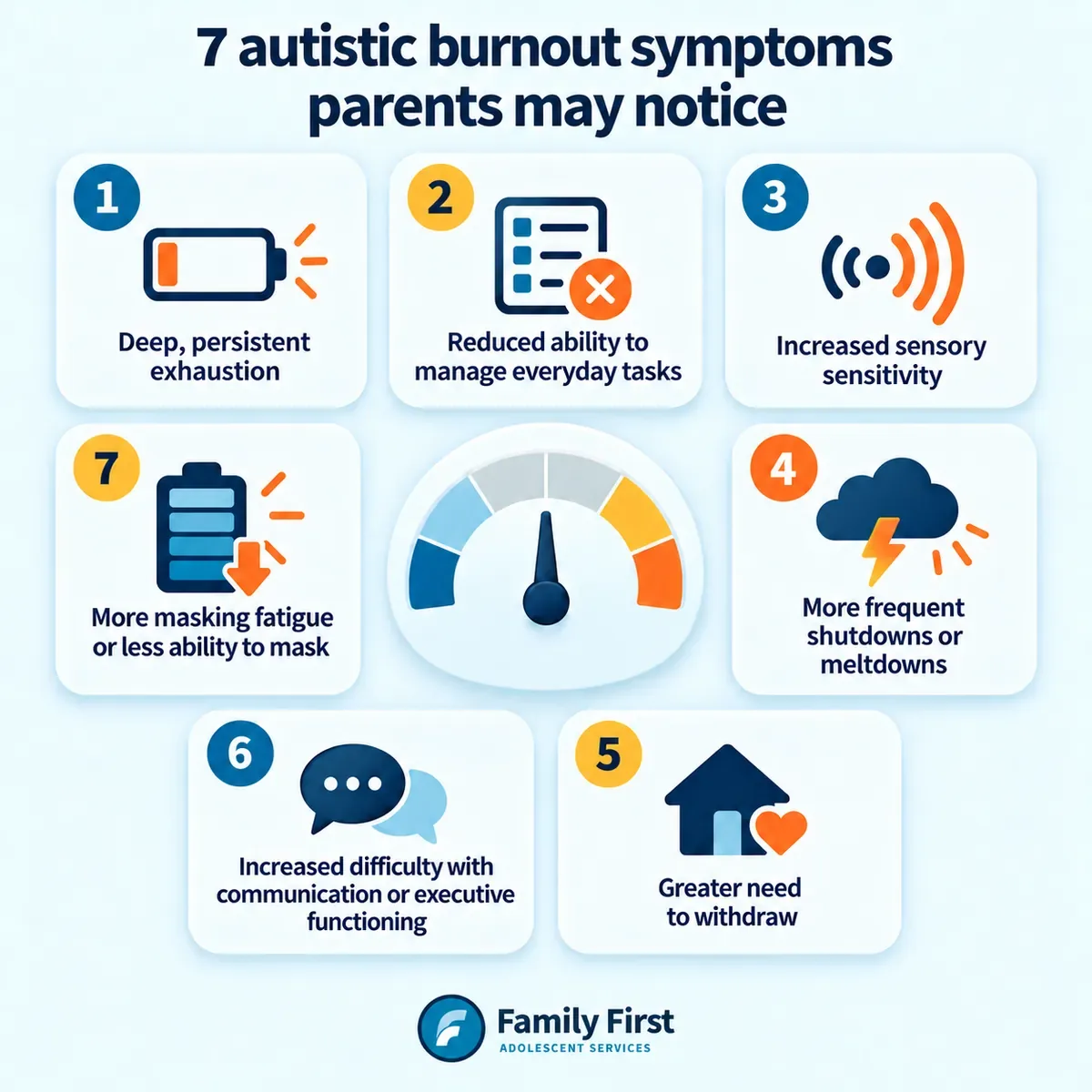
1. Deep, persistent exhaustion
A teen experiencing autistic burnout may seem tired in a way that rest does not quickly resolve. They may sleep more, need longer periods alone or have much less energy for school, hobbies and social activities.
This is different from being tired after a busy day. The pattern is often broader and more persistent.
2. Reduced ability to manage everyday tasks
Tasks that were once manageable may suddenly require much more effort. Your teen may struggle to start homework, shower, prepare for school, organize belongings or complete a familiar routine.
Reduced functioning is one of the central features of autistic burnout. This does not mean a teen has permanently “lost” skills. It may mean their available energy and ability to cope are temporarily reduced.
3. Increased sensory sensitivity
Sounds, lights, textures, crowds or other sensory input may become harder to tolerate. A classroom, family gathering or grocery store that was previously manageable may suddenly feel overwhelming.
Some teens may use headphones more often, avoid certain clothes, ask to leave noisy spaces or become distressed more quickly in stimulating environments.
4. More frequent shutdowns or meltdowns
When demands exceed a teen’s capacity, they may have more frequent meltdowns or shutdowns. A meltdown can involve intense outward distress. A shutdown may involve withdrawal, reduced speech, difficulty responding or a strong need to be alone.
These responses are not the same as intentional defiance. They can be signs that a teen is overwhelmed and may need fewer demands, more recovery time or additional support.
5. Greater need to withdraw
A teen may stop wanting to socialize, spend more time in a quiet room or pull back from activities they usually enjoy. In some cases, social withdrawal may help lower demands for a short period.
However, persistent withdrawal can also occur with depression or other mental health conditions. If your teen seems hopeless, loses interest in nearly everything or shows other concerning changes, a clinical evaluation is important.
6. Increased difficulty with communication or executive functioning
During burnout, some people with autism report more difficulty finding words, processing information, making decisions or shifting between tasks. For a teenager, this might look like taking longer to answer questions, becoming stuck when plans change or feeling unable to begin an assignment.
Executive functioning refers to mental skills used for planning, organizing, starting tasks and adjusting to change. These skills can become harder to use during periods of sustained stress.
7. More masking fatigue or less ability to mask
Masking means hiding or suppressing autistic traits to meet social expectations. A teen might copy peers, force eye contact, suppress stimming or work hard to appear comfortable when they are overwhelmed.
Over time, this effort can take significant energy. During burnout, a teen may have less energy to mask, or they may come home from school depleted after holding themselves together throughout the day.
What can contribute to autistic burnout?
There is no single cause that explains every experience. Autistic burnout may be associated with cumulative stress and a mismatch between demands and available support.
For teens, that load may include:
- Sensory overload — Busy classrooms, loud spaces or unpredictable environments may require sustained coping.
- Social pressure — Trying to interpret social cues, fit in or avoid standing out can take significant energy.
- Masking — Repeatedly hiding autistic traits may add to emotional and mental strain.
- School demands — Homework, deadlines, transitions and executive functioning demands can pile up.
- Major changes — A new school, family stress, changing routines or developmental transitions may increase pressure.
- Too little recovery time — A schedule with few quiet periods or restorative activities may leave little room to recharge.
Parents may find it helpful to look for patterns rather than one trigger. Burnout can reflect a buildup of demands over time, not one difficult event.
How parents can support autistic burnout recovery
Autistic burnout recovery is not a quick reset. Effective support may involve multiple steps, including:

- Reducing nonessential demands
If possible, temporarily scale back lower-priority commitments. A teen may need fewer social events, more transition time or a lighter schedule while their capacity is low.
This does not mean removing every expectation. It means deciding which demands are necessary and which can wait.
- Making the environment more sensory-friendly
Ask what feels overwhelming and what helps. Small changes may include dimmer lighting, quieter spaces, comfortable clothing, headphones or planned breaks during busy activities.
- Support communication without pressure
A teen who is overloaded may need extra processing time. Use clear language, ask one question at a time and avoid pushing for an immediate response when it is not necessary.
- Collaborate with their school
If burnout is affecting attendance or academic functioning, communicate with the school. Existing support through an Individualized Education Program (IEP), 504 Plan or other accommodations may need review.
School difficulty can also show up as avoidance or refusal when demands become too much.
Family First provides academic support as part of its programming, including adaptive strategies for neurodivergent students.
- Create more space for authenticity
Parents can help by reducing pressure to appear neurotypical at home. Safe stimming, focused interests, comfortable communication styles and reasonable sensory needs can be treated as valid parts of the teen’s experience.
A supportive home does not require ignoring boundaries. It means setting expectations in ways that respect the teen’s neurological needs.
- Watch for mental health or safety concerns
Burnout can overlap with anxiety, depression and other conditions. If your teen has persistent low mood, major sleep or appetite changes, severe withdrawal, self-harm thoughts or a sharp decline in functioning, seek professional support promptly.
A clinician can help evaluate whether the changes may relate to autistic burnout, another mental health condition, a medical issue or several factors at once. If they feel unsafe or may harm themselves, call or text 988 to reach the Suicide & Crisis Lifeline. If they’re at immediate risk, call 911 or take them to the emergency room.
When professional support may help
Consider reaching out for an assessment when your teen’s symptoms are lasting, worsening or interfering with school, relationships, self-care or safety. The purpose of an evaluation is not to force a label. It is to understand what your teen is experiencing and what level of support may be appropriate.
Family First offers neurodevelopmental care and parent and family support for adolescents whose needs require more structured behavioral health treatment. Family involvement is active throughout treatment. Regular communication is designed to help parents understand what their son is working on and how they can support him.
Fill out our admissions form or call our team today to learn how we can support your son, and your entire family, through this next step.
FAQs about autistic burnout
What is autistic burnout?
Autistic burnout is a term used to describe prolonged exhaustion, reduced functioning and greater sensitivity that some people with autism experience under sustained demands. Research is growing, but autistic burnout is not a standalone mental health diagnosis.
How long can autistic burnout last?
There is no fixed timeline. Research descriptions often involve long-lasting symptoms, but each person’s experience can differ. Persistent or worsening changes should be discussed with a qualified professional.
Can autistic burnout make sensory sensitivity worse?
Yes, some people with autism report that sound, light, touch and other sensory input become harder to tolerate during burnout. Parents may notice a teen needing quieter spaces or more sensory breaks.
Can autistic burnout affect school?
It can. Exhaustion, sensory overload, communication difficulty and reduced executive functioning may make attendance, homework and classroom participation a challenge.
What can parents do during autistic burnout?
Parents can reduce nonessential demands, offer sensory accommodations, allow more processing time and work with the school when needed. Professional guidance may also be useful when symptoms significantly affect daily functioning.
Is autistic burnout the same as depression?
No. They can share features such as fatigue and withdrawal, but they are not the same concept. Because symptoms can overlap, a qualified clinician can help assess what is contributing to a teen’s changes.
Is autistic burnout an official diagnosis?
No. Autistic burnout is an emerging research and lived-experience concept. It's not a standalone diagnosis in major U.S. diagnostic systems.
Can masking contribute to autistic burnout?
Research and autistic people’s accounts suggest sustained masking may contribute to the overall stress associated with burnout. Masking can require significant social, emotional and mental effort.
Should a teen with autism stay home from school during burnout?
That decision depends on the teen’s needs, safety and clinical situation. Families may benefit from working with health professionals and the school to decide whether accommodations, reduced demands or temporary schedule changes are appropriate.
When should parents seek professional support?
Consider professional support when changes persist, grow more severe or interfere with school, relationships, self-care or safety. Urgent evaluation is especially important when a teen expresses thoughts of self-harm or shows other immediate safety concerns.